
description Arabian Sands Overview
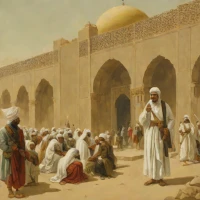
Traveling with Bedouin companions through the Rub' al Khali, Wilfred Thesiger describes desert journeys in which survival depends on local knowledge and mutual trust. Arabian Sands records his mid-twentieth-century experiences in the Empty Quarter and his admiration for the people who guided him through it. Physical hardship is closely tied to the social rules and obligations that make travel possible in such demanding conditions. The book also reflects a region undergoing political and material change.
Thesiger's account offers detailed observations of Bedouin life, but these remain the perspective of a particular traveler rather than a complete history of its peoples. It suits readers interested in desert exploration and cultural encounter, especially those willing to consider the author's strong preferences alongside his descriptions. Its defining quality is the importance it gives to companionship and desert expertise, rather than treating the journey as an individual conquest.
help Arabian Sands FAQ
Who wrote Arabian Sands and when was it published?
Arabian Sands was written by British explorer and writer Wilfred Thesiger and published in 1959. The book documents Thesiger's two crossings of the Rub' al Khali (the Empty Quarter) on foot and by camel in the late 1940s, at a time when the region was among the least-explored areas on Earth.
What desert does Arabian Sands describe?
The book centers on Thesiger's journeys through the Rub' al Khali, or 'Empty Quarter,' the largest continuous sand desert in the world, covering roughly 650,000 square kilometers across Saudi Arabia, Oman, Yemen, and the UAE. Thesiger's crossings were among the last great European explorations of the 20th century.
Who did Thesiger travel with during his crossings of the Empty Quarter?
Thesiger traveled with Bedouin companions, most notably his guides Bin Kabina and Bin Ghabaisha of the Rashid tribe. He regarded these men as equals and came to view their endurance, dignity, and survival skills as far superior to anything he had encountered elsewhere.
What is Thesiger's attitude toward modernization in Arabian Sands?
Arabian Sands is suffused with Thesiger's deep regret at the encroachment of modern civilization—oil wealth, motor vehicles, and political reorganization—on the traditional Bedu way of life. He wrote the book explicitly as an elegy for a vanishing world, and it has become a primary historical record of pre-oil Arabian Bedouin culture.
explore Explore More
Similar to Arabian Sands
compare_arrows Compare: A Short Walk in the Hindu Ku... See all arrow_forward


Reviews & Comments
Write a Review
Be the first to review
Share your thoughts with the community and help others make better decisions.


