
description Little Woodstar Overview
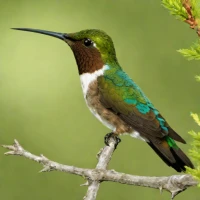
The little woodstar, Chaetocercus bombus, is a very small hummingbird found along the western side of the Andes in Ecuador and Peru. Males have a conspicuous violet throat patch and a short, forked tail, while females have different, less iridescent plumage. The species occupies forest edges, scrub, and flowering vegetation across a range of elevations, feeding on nectar and small arthropods, and is classified as Vulnerable because habitat loss and fragmentation affect its restricted range.
help Little Woodstar FAQ
Where can the Little Woodstar hummingbird be found?
The Little Woodstar (Chaetocercus bombus) is restricted to a narrow range in southwest Ecuador and northwest Peru, primarily in the Tumbesian dry-forest ecoregion. It inhabits lowland and foothill areas, typically below 1,500 meters in elevation.
How small is the Little Woodstar hummingbird?
The Little Woodstar is among the smallest hummingbird species in the world, measuring roughly 6 to 7 centimeters in total length. Its tiny size and rapid, bumblebee-like flight make it difficult to observe in the field.
Is the Little Woodstar endangered?
The IUCN classifies the Little Woodstar as Near Threatened, primarily due to ongoing habitat loss from deforestation and agricultural expansion in the Tumbesian region. Its restricted range makes remaining forest fragments especially important for the species' survival.
What does the Little Woodstar feed on?
Like other hummingbirds, the Little Woodstar feeds on nectar from flowering plants and catches small insects for protein. Its short, straight bill is suited to accessing small tubular flowers common in its dry-forest habitat.
explore Explore More


Reviews & Comments
Write a Review
Be the first to review
Share your thoughts with the community and help others make better decisions.


