
description Moog One Overview
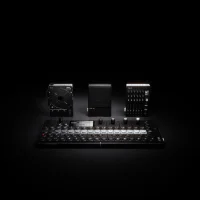
Designed for layered analog sound, the Moog One combines polyphonic synthesis with extensive modulation and a control panel built around hands-on editing. It was offered in eight-voice and sixteen-voice versions, rather than with five voices. Its architecture allows separate synthesizer parts to be layered or split across the keyboard, giving performers and composers room to build sounds with contrasting textures. Warm sustained chords and forceful bass sounds are both within its scope, but its appeal extends beyond familiar Moog tones.
Detailed routing and modulation support evolving patches that change throughout a performance. The substantial hardware and broad editing options suit studio musicians and sound designers who want a deep keyboard instrument. Its complexity rewards time spent learning the signal path and organizing patches for practical use.
help Moog One FAQ
Is the Moog One really polyphonic or is it closer to a classic mono Moog?
The Moog One is a true analog polyphonic synthesizer, sold in 8-voice and 16-voice versions. Unlike a Minimoog Model D, it can play full chords while still using Moog analog oscillators, filters, and envelopes.
Why do people compare the Moog One to a Sequential Prophet rather than a Voyager?
The Moog One is closer in role to big analog polysynths like the Sequential Prophet-10 or OB-X8 because it is built for layered polyphonic patches. A Voyager is a monophonic Moog lead and bass instrument, while the Moog One can run multiple timbres across its voice architecture.
Does the Moog One have built-in effects or do you still need outboard gear?
The Moog One includes onboard effects, including Eventide reverb algorithms. That matters because many vintage-style analog polysynths depend heavily on external delay and reverb to sound finished in a studio mix.
Is the Moog One a good choice for live performance?
It can be used live, but it is a large, expensive studio-grade instrument rather than a lightweight stage keyboard. Players usually buy it for deep sound design, tri-timbral patches, and hands-on control instead of portability.
explore Explore More



Reviews & Comments
Write a Review
Be the first to review
Share your thoughts with the community and help others make better decisions.


