
description Nördlingen Ries Overview
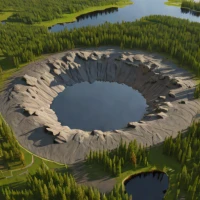
The Nördlingen Ries is a prominent impact crater located in Bavaria, Germany. Formed approximately 14 million years ago during the Miocene epoch, it represents a significant geological event. Its notable size and well-preserved features provide valuable insights into early Earth impacts and their effects on landscapes. Geologists and researchers studying impact craters and ancient geological formations utilize this site for analysis and understanding planetary processes.
help Nördlingen Ries FAQ
Is the town of Nördlingen actually built inside the Ries crater?
Yes, the medieval town of Nördlingen in Bavaria, Germany, is built entirely within the Nördlinger Ries impact crater. The town's 14th-century church, St. Georgskirche, was constructed using suevite—a distinctive impact-breccia rock formed by the meteorite collision—meaning many of the town's buildings are literally made from the crater's own stone.
How was the Nördlingen Ries proven to be an impact crater rather than a volcanic feature?
In the early 1960s, American geologist Eugene Shoemaker and colleague Edward Chao discovered coesite and stishovite—high-pressure forms of quartz that can only form during meteorite impacts—in rocks from the Ries. This discovery definitively proved the crater's impact origin and helped establish impact cratering as a legitimate geological process on Earth.
How old is the Nördlinger Ries crater, and what created it?
The crater was formed approximately 14 to 15 million years ago during the Miocene epoch when an asteroid roughly 1.5 kilometers in diameter struck what is now Bavaria. The impact created a crater about 24 kilometers across and devastated the surrounding landscape across central Europe.
Can visitors see suevite rock from the impact in buildings around Nördlingen?
Yes, suevite is visible in numerous buildings throughout Nördlingen, including the prominent St. Georgskirche tower that dominates the town's skyline. The local museum also displays shocked quartz and suevite specimens, and visitors can walk along the crater rim trail to observe geological features formed by the impact.
explore Explore More



Reviews & Comments
Write a Review
Be the first to review
Share your thoughts with the community and help others make better decisions.


