
description Seaside Goldenrod Overview
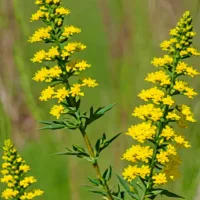
Seaside Goldenrod (*Solidago sempervirens*) is a herbaceous perennial belonging to the aster family, Asteraceae, found naturally along the Atlantic and Gulf coasts of North America. It is specifically adapted to harsh coastal environments, exhibiting high tolerance to salt spray, sandy soils, and occasional brackish flooding. Unlike many prairie goldenrods, this species typically lacks the aggressive rhizomatous spreading habit. It blooms in late summer and autumn, producing dense, club-shaped clusters of small yellow flowers that attract various pollinators.
help Seaside Goldenrod FAQ
Is Seaside Goldenrod invasive or aggressive in a garden setting?
Solidago sempervirens is a well-behaved native perennial that is less aggressive than many other goldenrod species. Its clumping growth habit and tolerance for poor, sandy soils make it a reliable choice for coastal and pollinator gardens.
How salt-tolerant is Seaside Goldenrod for coastal planting?
Seaside Goldenrod exhibits very high tolerance to salt spray and sandy, nutrient-poor soils, which is why it grows naturally directly along Atlantic and Gulf coast dunes. It is one of the most reliable plants for beachfront and seaside landscapes.
When does Seaside Goldenrod bloom?
Solidago sempervirens typically blooms from late summer into fall, producing dense, golden-yellow plumes that are a critical late-season nectar source. Monarch butterflies heavily rely on it during their autumn coastal migrations.
Can Seaside Goldenrod grow inland or does it need coastal conditions?
While it is specifically adapted to harsh coastal environments, Seaside Goldenrod will grow well inland in full sun and well-drained soil. However, it is particularly valuable in areas where salt spray or winter road salt would kill less adapted plants.
explore Explore More



Reviews & Comments
Write a Review
Be the first to review
Share your thoughts with the community and help others make better decisions.


