
description Whakaari (White Island) fumaroles Overview
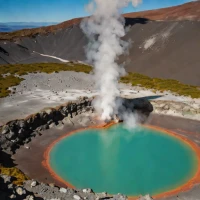
The fumaroles of Whakaari, also called White Island, are volcanic vents that release steam and gases from New Zealand's most active cone volcano. Whakaari is an andesitic stratovolcano in the Bay of Plenty, and much of the exposed island forms part of its crater complex, which contains fumaroles, acidic waters, and hydrothermally altered ground. The vents reflect an active geothermal system and occur in an environment subject to toxic gases and sudden eruptions.
help Whakaari (White Island) fumaroles FAQ
What toxic gases are emitted by the fumaroles on Whakaari (White Island)?
The fumaroles on this active andesite stratovolcano emit a highly toxic mixture of sulfur dioxide, hydrogen sulfide, and carbon dioxide. These gases react with water to form highly acidic fluids that heavily alter the crater landscape.
Why is the environment on Whakaari so dangerous for visitors?
The island is heavily covered in acidic crater lakes and high-temperature fumaroles that constantly feed explosive steam and toxic gases. The unpredictable nature of these geothermal vents contributed directly to the tragic 2019 volcanic eruption.
Where is Whakaari (White Island) located geographically?
Whakaari is an active marine stratovolcano located about 48 kilometers off the coast of the North Island of New Zealand in the Bay of Plenty. It sits within the highly active Taupo Volcanic Zone.
How hot do the fumaroles and crater lake on White Island get?
The high-temperature fumaroles and geothermal vents on Whakaari can reach scalding temperatures, with some steam emissions exceeding 100 degrees Celsius. The acidic crater lake itself frequently sits at temperatures around 50 degrees Celsius or hotter.
explore Explore More
Similar to Whakaari (White Island) fumaroles
compare_arrows Compare: Rotorua fumaroles See all arrow_forward


Reviews & Comments
Write a Review
Be the first to review
Share your thoughts with the community and help others make better decisions.


