
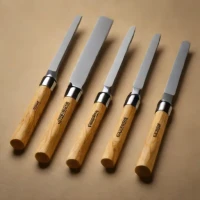
description Japanese Utility Chisel (Kanna Style) Overview
These chisels adopt Japanese principles, often featuring a thinner cross-section and a highly refined, acute edge geometry optimized for shearing wood fibers cleanly. They are exceptional for tasks requiring minimal tear-out, such as fine trim work or delicate carving where the cut must be whisper-quiet. While the handle style differs from Western tools, the resulting edge quality is superb for achieving glass-smooth surfaces on hardwoods.
help Japanese Utility Chisel (Kanna Style) FAQ
How is a Japanese Kanna-style chisel different from a Western bench chisel?
Japanese chisels (oiri nomi) typically feature a laminated construction—a hard, high-carbon steel cutting edge forge-welded to a softer iron body—and are designed to be struck with a mallet. Their thinner cross-section and more acute edge geometry (often around 25–30 degrees) allow for cleaner shearing cuts with minimal tear-out. Western bench chisels tend to have a single uniform steel hardness and steeper bevels for general-purpose work.
Do I need to use a special hammer with a Japanese chisel?
Yes, Japanese chisels have a hooped handle specifically designed to be struck with a steel hammer (genno) or a wooden mallet. The metal hoop at the top of the handle prevents the wood from splitting under repeated impact. Using a standard Western claw hammer can damage the hoop over time, so a dedicated Japanese hammer is recommended.
How often do I need to sharpen a Japanese chisel compared to a Western one?
Japanese chisels hold their edge longer due to the harder carbon steel used in the laminated cutting layer, but they also require more careful sharpening on waterstones. Honing frequency depends on use, but many woodworkers touch up the edge every few sessions with a fine-grit stone (6000+ grit). The harder steel also means the edge can chip if used on knots or hidden nails.
What is the hollow-back (urasuki) on a Japanese chisel and why does it matter?
The urasuki is a slight hollow depression forged into the flat back of a Japanese chisel blade. It dramatically reduces the surface area that needs to be flattened during sharpening, making it much easier to maintain a perfectly flat reference face. This design is a hallmark of quality Japanese chisel craftsmanship and is absent from most Western chisels.
explore Explore More
Similar to Japanese Utility Chisel (Kanna Style)
compare_arrows Compare: Robert Sorby Paring Chisel S... See all arrow_forward

Reviews & Comments
Write a Review
Be the first to review
Share your thoughts with the community and help others make better decisions.


