
description Bombus terrestris Overview
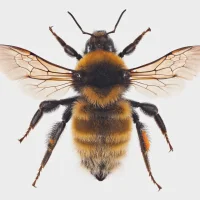
The buff-tailed bumblebee, Bombus terrestris, is a widespread living species native to Europe. Its dark, hairy body carries pale yellow bands, while the queen's buff-colored tail gives the species its common name. Colonies usually nest underground, often occupying abandoned rodent burrows. This means that subterranean nesting commonly involves using an existing cavity, rather than excavating an entirely new nest without one.
Workers collect pollen and nectar from wildflowers and crops, making the species relevant to both natural plant communities and agriculture. It is also commercially reared for crop pollination, particularly in protected growing environments. Farmers value its pollinating activity, while researchers study its foraging and colony behavior. For conservationists, it offers a way to examine how a familiar European bumblebee interacts with changing habitats and other pollinators.
help Bombus terrestris FAQ
Where is Bombus terrestris found and what is its nesting style?
Bombus terrestris is widespread across Europe. Unlike many species, it is noted for subterranean nesting behavior.
Why is Bombus terrestris important for agriculture?
It plays a major role in pollinating wildflowers and crops. That ecological function is why it appears in pollinator management and biodiversity studies.
Which industries look at this species for practical monitoring?
Farmers and pollination researchers commonly monitor this bee for ecosystem and crop impacts. Both use it as an indicator for practical pollinator ecology.
What distinguishes this bumblebee from cavity-nesting bee species?
The species often prefers underground nests, which affects where colonies are likely to be found. That behavior is one of its most practical identification notes.
explore Explore More


Reviews & Comments
Write a Review
Be the first to review
Share your thoughts with the community and help others make better decisions.


