
description Celestron NexStar 6SE Overview
The Celestron NexStar 6SE pairs a compact Schmidt-Cassegrain optical tube with a computerized GoTo mount. After setup and alignment, the system can locate objects from its database and track them as the sky appears to move. Its folded optical design fits a relatively long focal length into a short tube, making the telescope practical to transport while retaining a focus suited to detailed lunar and planetary viewing. With a six-inch aperture and a nominal 1,500mm focal length, it favors narrower views over expansive star fields.
It suits beginners willing to learn alignment and observers who prefer electronic object finding to manual searching. The aperture is smaller than that of many larger reflectors, but portability and tracking provide a different balance. Automation reduces some of the work of finding targets; observing conditions and eyepiece choice still shape what can be seen.
help Celestron NexStar 6SE FAQ
What can you see with a Celestron NexStar 6SE?
The NexStar 6SE is a 6-inch, 150 mm Schmidt-Cassegrain telescope, so it can show the Moon, Jupiter's cloud bands, Saturn's rings, brighter nebulae, star clusters, and some galaxies under dark skies. Light pollution affects deep-sky objects much more than lunar and planetary viewing.
Does the NexStar 6SE find objects automatically?
Yes, the SE mount is computerized and uses Celestron's GoTo system to point at objects after alignment. Celestron advertises a database of more than 40,000 celestial objects for this class of hand controller.
Is the NexStar 6SE good for astrophotography?
It can take lunar and planetary images with a camera, but the single-arm alt-azimuth mount is not ideal for long-exposure deep-sky astrophotography. For nebula and galaxy imaging, people usually move to an equatorial mount such as Celestron AVX or Sky-Watcher HEQ5.
How does the NexStar 6SE compare with the NexStar 8SE?
The 8SE has an 8-inch aperture, so it gathers noticeably more light than the 6SE, but it is also heavier and more demanding on the same style of mount. The 6SE is the easier middle ground for portability, price, and planetary viewing.
explore Explore More
Similar to Celestron NexStar 6SE
compare_arrows Compare: Celestron EdgeHD 14" Schmidt... See all arrow_forward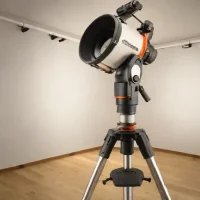


Reviews & Comments
Write a Review
Be the first to review
Share your thoughts with the community and help others make better decisions.


