
description Grimaldi Overview
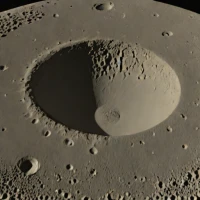
Grimaldi is a large lunar impact basin near the western limb of the Moon, southwest of Oceanus Procellarum. Its broad interior, roughly 170 kilometers across, was flooded by dark basaltic lava, producing a smooth floor that contrasts strongly with the surrounding highlands. The basin is visible from Earth under favorable illumination, although its position near the limb makes it appear foreshortened.
help Grimaldi FAQ
Where is the Grimaldi crater on the moon?
The Grimaldi crater is located on the western edge of the moon's near side, just on the edge of the Oceanus Procellarum. It sits south of another famous crater, Riccioli. It is easily visible from Earth with a standard pair of binoculars during certain lunar phases.
Why does the Grimaldi crater look so dark?
Grimaldi's dark appearance is due to its floor being flooded with ancient basaltic lava following the initial impact. This flat, dark basalt contrasts sharply with the lighter, cratered lunar highlands surrounding it. It creates a distinct "bullseye" effect when viewed through a telescope.
How wide is the Grimaldi crater?
Grimaldi is a massive walled plain with a diameter of approximately 165 kilometers (over 100 miles). The crater is so large that its dark floor forms one of the most prominent dark spots visible on the near side of the Moon. Its outer ramparts rise significantly above the surrounding terrain.
Who is the Grimaldi crater named after?
The crater is named in honor of Francesco Maria Grimaldi, a 17th-century Italian Jesuit priest and physicist. He is famous for building the first detailed map of the moon's surface alongside Giovanni Riccioli. The neighboring crater, Riccioli, is named after his mapping partner.
explore Explore More


Reviews & Comments
Write a Review
Be the first to review
Share your thoughts with the community and help others make better decisions.


