
description Sand Fiddler Crab Overview
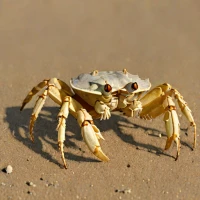
The sand fiddler crab is a small intertidal crab of the fiddler-crab group, commonly associated with sandy beaches, tidal flats, and salt-marsh margins along the Atlantic coast of North America. Males have one greatly enlarged claw, which they wave during courtship and territorial displays, while the other claw remains small and is used in feeding. Individuals excavate burrows in sediment and feed by sorting organic particles from sand or mud.
help Sand Fiddler Crab FAQ
What species is commonly called the sand fiddler crab?
The Atlantic sand fiddler crab is commonly identified as Leptuca pugilator. It occurs along the Atlantic coast of North America, from Massachusetts south through the Gulf of Mexico. [Sand fiddler crab](https://en.wikipedia.org/wiki/Leptuca_pugilator)
Why does a male sand fiddler crab have one huge claw?
The male waves the enlarged claw to attract females and uses it in territorial contests near his burrow. The motion looks like playing a fiddle, which explains the common name. [National Park Service](https://www.nps.gov/pais/learn/nature/fiddlercrab.htm)
Where do sand fiddler crabs usually live?
They occupy soft sand or mudflats near salt marshes and tidal channels. A male often positions himself beside a small burrow while waving his claw during courtship. [National Park Service](https://www.nps.gov/pais/learn/nature/fiddlercrab.htm)
Do sand fiddler crabs actually make music?
No, the name refers to the male's claw-waving display rather than to a musical sound. The display is a courtship and territory signal used by the male Leptuca pugilator. [Sand fiddler crab](https://en.wikipedia.org/wiki/Leptuca_pugilator)
explore Explore More



Reviews & Comments
Write a Review
Be the first to review
Share your thoughts with the community and help others make better decisions.


