
description SN 1987A Remnant Overview
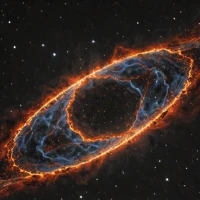
The SN 1987A remnant is a glowing nebula formed by the explosion of a star in the Large Magellanic Cloud. This supernova event, occurring in 1987, created a vast cloud of expanding gas and dust—the most studied supernova remnant to date. It’s notable for its complex structure and provides valuable insights into stellar death processes. Astronomers study this remnant to understand supernovae and their impact on surrounding interstellar environments, particularly those observing star formation regions like the Dorado molecular cloud.
help SN 1987A Remnant FAQ
When did Supernova 1987A occur?
Supernova 1987A was first observed on February 23, 1987, in the Large Magellanic Cloud, a satellite galaxy of the Milky Way. It was the brightest supernova visible from Earth in nearly 400 years.
Why is SN 1987A important to astronomers?
SN 1987A was the first supernova visible to the naked eye since Kepler's Supernova of 1604, and the first to be detected in neutrinos before being seen optically. The detection of neutrinos at facilities such as Japan's Kamiokande experiment confirmed core-collapse supernova theory.
What kind of star produced SN 1987A?
The progenitor star, catalogued as Sanduleak −69° 202, was a blue supergiant—surprising astronomers, who had expected only red supergiants to produce core-collapse supernovae. The discovery forced a revision of stellar evolution models for massive stars.
Where is SN 1987A located?
SN 1987A is located in the Large Magellanic Cloud (LMC), a dwarf galaxy orbiting the Milky Way at a distance of approximately 168,000 light-years. The LMC is visible to the naked eye from the Southern Hemisphere.
explore Explore More
Similar to SN 1987A Remnant
compare_arrows Compare: Tarantula Nebula (NGC 2070) See all arrow_forward


Reviews & Comments
Write a Review
Be the first to review
Share your thoughts with the community and help others make better decisions.


