
description Stromboli fumaroles Overview
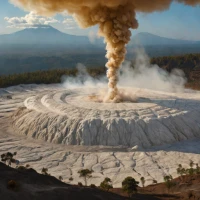
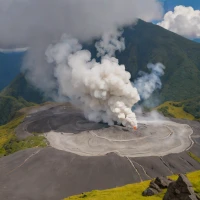
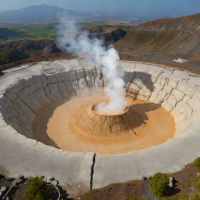
Stromboli, an active volcano in Italy's Aeolian Islands, is characterized by persistent explosive eruptions that have earned it the nickname "Lighthouse of the Mediterranean." Fumaroles dot the volcano's slopes, particularly along the Sciara del Fuoco, a large collapse scar where incandescent material regularly flows into the sea. These openings emit steam and volcanic gases, including sulfur dioxide and carbon dioxide, providing scientists with valuable data about the volcano's internal processes. Stromboli's nearly continuous activity, lasting for over 2,000 years, makes it one of the world's most closely monitored volcanoes.
help Stromboli fumaroles FAQ
Why is Stromboli called the Lighthouse of the Mediterranean?
Stromboli is nicknamed the 'Lighthouse of the Mediterranean' because of its persistent explosive eruptions that occur at regular intervals—often every 20 to 30 minutes—producing visible glowing arcs of lava at night. This near-continuous activity has been observed for centuries and made the volcano a navigational landmark for sailors.
Where are the fumaroles located on Stromboli?
Fumaroles on Stromboli are found along the volcano's slopes, particularly near the Sciara del Fuoco—a large collapse scar on the northwest flank where lava and debris flow into the sea. Additional fumarolic activity is present near the summit crater area, emitting sulfurous gases and steam.
What are the Aeolian Islands where Stromboli is located?
Stromboli is one of the Aeolian Islands (Isole Eolie), a volcanic archipelago north of Sicily in the Tyrrhenian Sea. The Aeolian Islands are a UNESCO World Heritage Site and include seven main islands, several of which feature active or dormant volcanic systems.
Can you hike to the summit of Stromboli volcano?
Guided hikes to Stromboli's summit crater area are permitted, but access is regulated and requires a certified volcanic guide due to the ongoing eruptive activity. The hike typically begins in the late afternoon to reach the summit by sunset, allowing hikers to observe nighttime eruptive activity.
explore Explore More
Similar to Stromboli fumaroles
compare_arrows Compare: Gran Cratere fumaroles (Vulc... See all arrow_forward
Reviews & Comments
Write a Review
Be the first to review
Share your thoughts with the community and help others make better decisions.


