
description Kare-Kare (Filipino) Overview
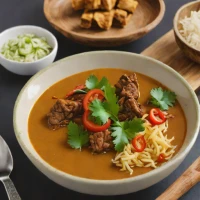
Kare-Kare is a rich Filipino curry notable for its distinctive creamy sauce made from peanuts and coconut milk. Traditionally prepared with oxtail, it’s a staple at festive occasions and celebrations throughout the Philippines. It's particularly enjoyed by those seeking authentic Southeast Asian cuisine and often served alongside bagoong, a fermented shrimp paste.
help Kare-Kare (Filipino) FAQ
What gives Kare-Kare its distinctive orange-yellow color in the sauce?
The signature color comes from atsuete, also known as annatto (achiote) seeds, which are steeped in warm water or oil to extract their vibrant orange pigment. Annatto is a traditional coloring and flavoring agent in Filipino cuisine that was introduced during the Spanish colonial era and has become inseparable from authentic Kare-Kare.
Is bagoong (shrimp paste) traditionally served as a condiment with Kare-Kare?
Yes, Kare-Kare is almost always served with bagoong alamang—a fermented shrimp paste that provides a salty, umami contrast to the dish's mild, nutty sauce. Most Filipinos consider Kare-Kare incomplete without bagoong on the side, as the rich peanut sauce on its own is relatively understated in seasoning.
How does Kare-Kare compare to other Southeast Asian peanut-based dishes like Thai Massaman curry?
While both dishes use peanuts or peanut sauce as a base, Kare-Kare is thicker, less spicy, and does not use coconut milk as its primary liquid—coconut milk is optional and often omitted in favor of ground rice as a thickener. Thai Massaman curry incorporates a complex spice paste with dried chilies, cardamom, and cinnamon, whereas Kare-Kare relies on a simpler flavor profile of peanuts, annatto, and toasted rice.
What proteins are traditionally used in authentic Kare-Kare besides oxtail?
Beyond oxtail, traditional Kare-Kare often includes beef tripe, pork hocks, and sometimes pork belly, with the combination varying by household and region. Many versions also incorporate vegetables such as eggplant, string beans, bok choy (pechay), and banana hearts (puso ng saging) to complement the rich, sticky sauce.
explore Explore More
Similar to Kare-Kare (Filipino)
See all arrow_forward


Reviews & Comments
Write a Review
Be the first to review
Share your thoughts with the community and help others make better decisions.


