
description Common Evening Primrose Overview
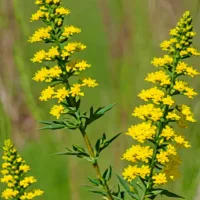
The Common Evening Primrose (*Oenothera biennis*) is a herbaceous biennial belonging to the willowherb family, Onagraceae, native to eastern and central North America. It forms a rosette of leaves in its first year before sending up a tall, flowering spike in its second. The plant is notable for its yellow flowers, which typically open in the evening and close by the following noon. The seeds of the plant are commercially processed to extract evening primrose oil, a dietary supplement.
help Common Evening Primrose FAQ
What is the medicinal use of Common Evening Primrose oil?
Evening primrose oil, extracted from the seeds of Oenothera biennis, is a popular dietary supplement rich in gamma-linolenic acid (GLA), an omega-6 fatty acid. It is commonly used to treat symptoms of eczema, premenstrual syndrome, and rheumatoid arthritis, though clinical studies show mixed results.
How does the biennial life cycle of Common Evening Primrose work?
Oenothera biennis forms a flat rosette of leaves close to the ground during its first year, storing energy in a thick taproot. In its second year, it sends up a tall flowering spike that blooms, sets seed, and then the entire plant dies.
Why is Common Evening Primrose open at night?
The yellow flowers of Common Evening Primrose open in the late afternoon and evening to attract night-flying pollinators, particularly certain species of moths. The flowers are also brightly visible under ultraviolet light, which guides these insects to the nectar.
How tall does Common Evening Primrose grow?
In its second-year flowering stage, Oenothera biennis can reach 3 to 6 feet tall, producing a sturdy, erect spike covered in bright yellow blooms. The plant readily self-seeds and can become weedy in disturbed soils and old fields.
explore Explore More



Reviews & Comments
Write a Review
Be the first to review
Share your thoughts with the community and help others make better decisions.


