
description Hertzsprung Basin Overview
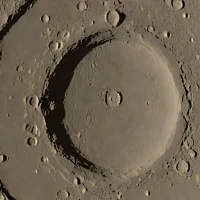
The Hertzsprung Basin is an immense impact crater situated on the far side of the Moon. Measuring approximately 570 kilometers in diameter, it is classified as a multi-ring impact basin rather than a standard crater. The interior of Hertzsprung is heavily eroded and contains a distinct peak-ring structure, as well as several smaller, younger craters superimposed on its floor. Its geological age is estimated to date back to the Nectarian period, representing a major impact event that significantly altered the Moon's crust.
help Hertzsprung Basin FAQ
Why can Hertzsprung Basin never be seen directly from Earth?
Hertzsprung lies on the Moon's far side, which is permanently turned away from Earth because the Moon is tidally locked. It can therefore be observed directly only by spacecraft orbiting or passing behind the Moon.
How large is the Hertzsprung Basin?
The basin spans roughly 570 kilometers, making it one of the Moon's largest impact structures. Its scale is several times greater than prominent near-side craters such as Copernicus or Tycho.
What is a peak-ring basin like Hertzsprung?
A peak-ring basin contains an internal ring of mountains created as the crust rebounded and collapsed after an enormous impact. Hertzsprung preserves this structure despite extensive later cratering across its floor and rim.
Who is Hertzsprung Basin named after?
It honors Danish astronomer Ejnar Hertzsprung. He independently helped establish the relationship between stellar luminosity and temperature represented in the Hertzsprung-Russell diagram.
explore Explore More


Reviews & Comments
Write a Review
Be the first to review
Share your thoughts with the community and help others make better decisions.


