
description Schistocerca cancellata Overview
Schistocerca cancellata, the South American locust, is a major agricultural pest species in South America. It has historically caused significant damage to crops in Argentina, Uruguay, and neighboring countries. The species has a documented record of outbreak cycles spanning centuries and forms large, migratory swarms under favorable conditions.
help Schistocerca cancellata FAQ
Why is Schistocerca cancellata called the South American locust?
It is a locust species native to southern South America whose dense populations can change behavior and form migratory swarms. Argentina has recorded destructive outbreaks of the species for centuries.
Which crops are threatened by Schistocerca cancellata swarms?
Swarms can consume maize, pasture, fruit crops, and other vegetation across agricultural regions. The pest affects Argentina and can move into neighboring Paraguay, Bolivia, Uruguay, and Brazil.
What turns solitary Schistocerca cancellata into a swarm?
Crowding after favorable breeding conditions triggers a phase change in behavior, coloration, and movement. The gregarious insects then gather into bands as juveniles and mobile swarms as adults.
Is the South American locust the same species as the desert locust?
No. Schistocerca cancellata is South American, while the desert locust is Schistocerca gregaria and occurs mainly across Africa, the Middle East, and southwestern Asia.
explore Explore More
Similar to Schistocerca cancellata
See all arrow_forward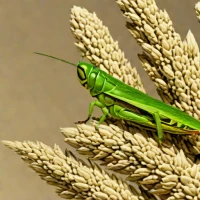


Reviews & Comments
Write a Review
Be the first to review
Share your thoughts with the community and help others make better decisions.


