
description Sudbury Basin Overview
The Sudbury Basin is a massive impact crater formed approximately 1.85 billion years ago in present-day Canada. It represents one of Earth’s oldest and largest known impact structures. The basin's distinctive nickel-iron sulfide deposits are exceptionally valuable for studying the early evolution of our planet and provide significant geological resources. Geologists, mineralogists, and researchers investigating Precambrian geology utilize the site extensively.
help Sudbury Basin FAQ
How old is the Sudbury Basin impact crater?
The Sudbury Basin was formed approximately 1.85 billion years ago during the Paleoproterozoic era. It is one of the oldest and largest known impact craters on Earth, originally measuring up to 150 kilometers across.
What kind of minerals are mined in the Sudbury Basin?
The crater is world-renowned for its massive nickel-copper-palladium sulfide deposits. Mining operations in the Sudbury area, heavily driven by companies like Vale and Glencore, produce a significant percentage of the world's nickel supply.
What created the Sudbury Basin?
The basin was created when a massive comet or asteroid, estimated to be about 10 to 15 kilometers in diameter, slammed into the Earth. The sheer force of the impact melted the crust, creating a massive sheet of impact melt known as the Sudbury Igneous Complex.
Is the Sudbury Basin visible from space?
While erosion and billions of years of geological activity have deformed its shape, the sheer scale of the Sudbury Basin makes it recognizable from aerial and satellite imagery. The modern geological structure forms a distinct, elongated depression in Ontario, Canada.
explore Explore More
Similar to Sudbury Basin
See all arrow_forward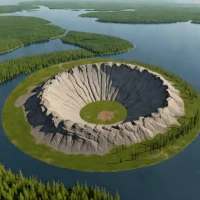


Reviews & Comments
Write a Review
Be the first to review
Share your thoughts with the community and help others make better decisions.


